
Iowa Courts Online is a central source for finding court records, case information, and judicial resources from courts throughout Iowa. Many people use Iowa Courts Online Search to check case details, review court filings, search court dockets, and find information related to civil, criminal, family, probate, traffic, and small claims cases. The system supports public court record searches across Iowa’s court network and helps users locate court information from different counties. It serves as an important part of the Iowa Judicial Branch and provides court-related information through an online court portal. Users often search by case number, party name, filing date, or court location to locate available records and case details.
The Iowa Court System includes the Iowa Supreme Court, Iowa Court of Appeals, and Iowa District Courts that serve all 99 counties across the state. Through Iowa courts, the public can find information about court services, court forms, judicial districts, clerk of court offices, hearing schedules, court procedures, and legal filings. Court records may include case status updates, docket entries, court orders, judgments, and other publicly available information. This page covers key topics related to Iowa Courts, including court records, case search options, court structure, public records, online court services, and court resources that help users find accurate and up-to-date court information throughout Iowa.
How to Use Iowa Courts Online Search
Iowa Courts Online Search lets users check court case details and review case records through a statewide system. Iowa Court Search provides structured case information such as filings, status, and docket entries in one place. This system supports quick case lookup across Iowa judicial districts.
- https://www.iowacourts.gov/
How Iowa Courts Online Search Works
The Iowa Courts Online Search system pulls case data from district courts across the state. It helps users perform a court records search, review docket search results, and track case status updates.
Search results typically show:
- https://www.iowacourts.state.ia.us/ESAWebApp/SelectFrame
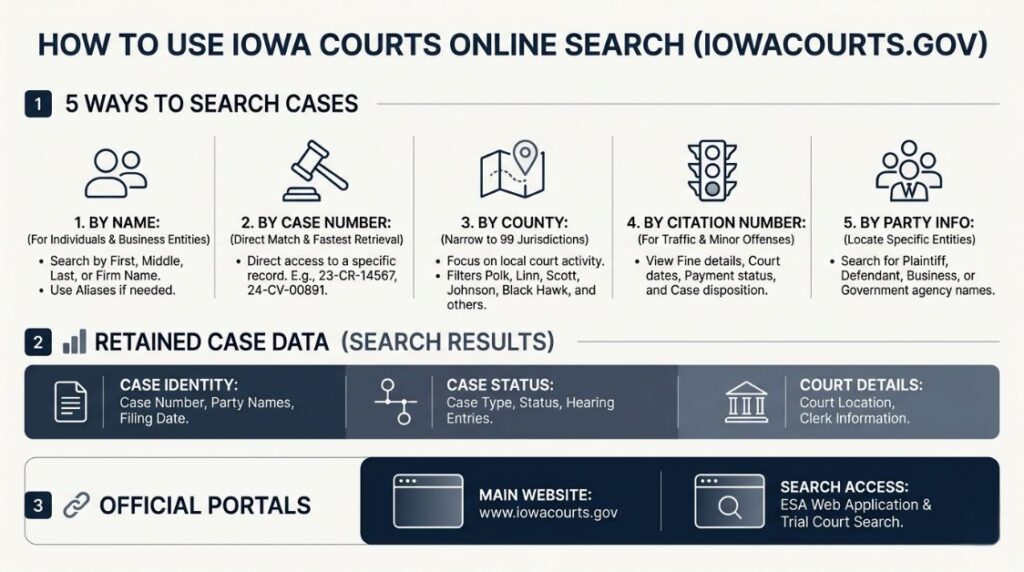
- Case number
- Party names
- Filing date
- Court location
- Case type
- Current status
- Hearing entries
This structure supports fast case lookup without needing courthouse visits. Users can filter results based on different search inputs depending on available details.
Search Search by Name
The most common search method is a name-based lookup. Through the Iowa Courts Online Name Search page, users can search for court records by entering a person’s name or a business name. This option is useful when a case number is unavailable and allows users to locate records using party information.
Available Search Fields
Users can search using the following information:
- https://www.iowacourts.state.ia.us/ESAWebApp/TrialSimpFrame
- Case Type Filter
- Last/Firm Name
- First Name
- Middle Name
- Alias Last/Firm Name
- Alias First Name
- Alias Middle Name
- Role Selection
- County Filter
Search by Case Number
Case number search gives the most direct results inside the Iowa Courts Online Search. Each case in the system carries a unique identifier assigned by the court clerk.
Why is the case number search effective?
- Direct match with one record
- Faster retrieval than name search
- Reduces unrelated results
Example case format:
- 23-CR-14567 (Criminal case)
- 24-CV-00891 (Civil case)
This method is widely used for tracking case status or reviewing docket history in a structured way.
Search by County
County-based search helps narrow results to a specific jurisdiction. Iowa has 99 counties, and each district court handles cases within its area.
Users select a county when:
- The filing location is known
- Searching for local court activity
- Reviewing district-specific records
County filters:
- Polk County
- Linn County
- Scott County
- Johnson County
- Black Hawk County
County selection improves precision in court search records and removes unrelated statewide results.
Search by Citation Number
Citation number search is often used for traffic and minor offense cases. Each citation issued by law enforcement carries a unique number linked to court records.
Use cases:
- Traffic violations
- Parking tickets
- Minor infractions
- Municipal citations
Citation search helps users find:
- Fine details
- Court date
- Payment status
- Case disposition
This method supports a quick review of court case lookup for simple offenses.
Search by Party Information
Party-based search allows users to locate cases involving specific individuals or organizations. This method is useful when only partial case details are known.
Party search includes:
- Plaintiff names
- Defendant names
- Business entities
- Government agencies
Users often combine party search with filters such as:
- County
- Case type
- Date range
This improves accuracy in court records search results and helps isolate relevant cases from large datasets.
Pinch to zoom. Tap a county to select it, then tap again to open the page.
Iowa Court Records Available Online
Iowa Court Records include information from civil, criminal, family, probate, traffic, and small claims cases filed in the state’s court system. Many public court records and case details can be viewed through Iowa Courts Online, though certain judicial records remain restricted by law. Iowa Courts Online serves as a central source for reviewing case information from courts across the state. The system contains a wide range of court documents, docket entries, hearing dates, case status updates, and other judicial records that may be available for public review. The type of information available depends on the case category, court rules, and privacy laws. Some records can be viewed online, while certified copies and complete court files may require a request through the appropriate Clerk of Court office.
Types of Iowa Court Records Commonly Found Online
The Iowa court system handles many categories of legal matters. Each case type creates records that may contain different information.
| Case Category | Common Information Available |
|---|---|
| Civil Cases | Lawsuits, contract disputes, property disputes |
| Criminal Cases | Charges, hearings, court actions, judgments |
| Family Cases | Divorce proceedings, custody matters, support cases |
| Probate Cases | Estates, wills, guardianships, conservatorships |
| Traffic Cases | Traffic violations, citations, court appearances |
| Small Claims Cases | Minor financial disputes and collection actions |
Civil Cases
Civil cases involve disputes between parties where compensation, property rights, or other legal remedies are requested. These matters do not involve criminal prosecution.
Iowa Court Records Online may contain information from various civil proceedings, including:
- Contract disputes
- Property disputes
- Personal injury claims
- Consumer complaints
- Business litigation
- Landlord-tenant matters
Public court records for civil cases often include case numbers, filing dates, party names, court orders, motions, and judgment information. In many situations, docket entries provide a timeline showing how a case progressed through the court system.
Criminal Cases
Criminal court records relate to cases where state prosecutors file charges alleging violations of Iowa law. These judicial records often generate significant public interest due to their role in the criminal justice process.
Information that may appear within criminal court records includes:
- Case identification numbers
- Criminal charges
- Court appearances
- Plea information
- Sentencing details
- Disposition status
Public availability varies depending on the nature of the case. Records connected to sealed matters, expungements, juvenile proceedings, or active investigations may not appear in public searches.
Family Cases
Family court matters are generally handled through the Iowa District Courts. These cases address legal issues involving family relationships and domestic matters.
Common family case records include:
- Divorce proceedings
- Child custody disputes
- Child support actions
- Paternity cases
- Protective orders
- Family law motions
Some family court records remain available for public review, while others contain protected information. Courts often restrict sensitive details involving children or confidential personal information.
Probate Cases
Probate records involve the administration of estates after a person’s death. They may include documents related to wills, estate management, guardianships, and conservatorships.
Probate judicial records frequently contain:
- Estate filings
- Executor appointments
- Will submissions
- Guardianship petitions
- Conservatorship proceedings
- Asset administration records
Researchers often review probate court documents to verify estate activity, fiduciary appointments, or court-approved actions involving property and assets.
Traffic Cases
Traffic cases represent a large portion of filings within Iowa courts. Many involve traffic citations, moving violations, and related court proceedings.
Traffic-related court records may contain:
- Citation details
- Hearing schedules
- Violation descriptions
- Fine assessments
- Court decisions
- Payment status information
Many traffic records appear within online court databases, making case tracking simpler for drivers, attorneys, and other interested parties.
Small Claims Cases
Small claims cases involve disputes seeking relatively modest financial recovery. These proceedings provide a simplified court process compared to traditional civil litigation.
Small claims matters include:
- Unpaid debts
- Security deposit disputes
- Property damage claims
- Contract disagreements
- Consumer complaints
Small claims court records often include filing information, hearing dates, judgments, and collection-related actions. These records help parties monitor case progress and review court decisions.
Information Commonly Found in Iowa Court Records
Many public court records contain core case details that help identify and track proceedings within the Iowa court system.
Typical information may include:
- Case number
- Case type
- Party names
- Filing date
- Court location
- Hearing schedule
- Judge assignment
- Case status
- Court orders
- Final disposition
The availability of specific court documents depends on court policies, privacy protections, and record classification. As a result, some judicial records may appear in full, while others show limited information within public search results.
Iowa Court Records: Public vs Confidential
Many Public Court Records in Iowa can be viewed through the court systems and clerk’s offices. At the same time, certain State of Iowa Court Records remain restricted to protect privacy, safety, and sensitive legal matters. The Iowa Judicial Branch maintains a balance between public transparency and personal privacy. As a result, some records are open for public review, while others are protected by state law or court orders.
Records Available to the Public
A large portion of Iowa court information falls under public record laws. These records help people review case activity, court decisions, and judicial proceedings.
Public court records may include:
- Case numbers
- Party names
- Filing dates
- Hearing dates
- Court orders
- Judgments
- Case status updates
- Docket entries
- Traffic case information
- Small claims case records
In many situations, court users can search records by name, case number, or county. Public information supports transparency within the Iowa court system and allows citizens to review many court proceedings.
The table below shows examples of records that are often available to the public:
| Record Type | Public Availability |
|---|---|
| Civil Cases | Usually Available |
| Criminal Cases | Usually Available |
| Traffic Cases | Usually Available |
| Small Claims Cases | Usually Available |
| Probate Cases | Often Available |
| Court Dockets | Usually Available |
Records Restricted by Law
Some court files contain personal or sensitive information. State law limits public viewing of these materials to protect privacy rights and confidential proceedings.
Restricted records may include:
- Social Security numbers
- Financial account information
- Medical details
- Protected witness information
- Certain law enforcement records
- Court-sealed documents
Courts may redact specific details before releasing a document. In some cases, an entire file may remain unavailable for public review.
Juvenile Records
Most juvenile court matters receive special privacy protections. These cases often involve minors and sensitive family circumstances.
Examples include:
- Juvenile delinquency proceedings
- Child protection matters
- Child in need of assistance cases
- Adoption-related filings
- Termination of parental rights proceedings
Public viewing of juvenile files is often limited. Courts restrict these records to protect children and preserve confidentiality throughout the legal process.
Mental Health Records
Mental health proceedings contain highly sensitive personal information. Iowa courts place strict limits on the release of these records.
Protected files may involve:
- Mental health commitments
- Substance use treatment proceedings
- Psychiatric evaluations
- Medical reports submitted to the court
These records usually remain confidential and are accessible only to authorized parties, attorneys, healthcare providers, or the court.
Expunged Cases
An expunged record is different from a public case file. When a court grants an expungement, the record is removed from standard public searches and no longer appears in most public court databases.
Points about expunged records include:
- The case is removed from routine public searches.
- Public users generally cannot view the file.
- Certain government agencies may still retain limited records under state law.
- Expungement does not always erase every historical reference connected to a case.
Similarly, sealed records remain part of the court file but are hidden from public view. Courts may seal records to protect privacy interests, ongoing investigations, or sensitive legal matters.
The Iowa Court System
The Iowa Court System operates under the Iowa Judicial Branch, which manages courts across all 99 counties. The State of Iowa Courts follows a unified court structure that includes trial courts, appellate courts, and specialized divisions responsible for handling civil, criminal, family, probate, and business-related matters. This structure helps courts process cases consistently throughout the state while providing court services at both local and statewide levels.
Iowa Supreme Court
The Iowa Supreme Court serves as the highest court within the state judiciary and has the final authority on questions involving Iowa law. The court reviews selected appeals from lower courts, interprets constitutional issues, oversees the administration of the judicial branch, and establishes rules that govern court procedures. Decisions issued by the Iowa Supreme Court are binding on all lower courts throughout Iowa and often influence how laws are applied in future cases.
Iowa Court of Appeals
The Iowa Court of Appeals serves as the state’s intermediate appellate court. It helps reduce the workload of the Iowa Supreme Court by reviewing many appeals that originate in district courts. When a party disagrees with a district court decision, the appeal often reaches this court first. A panel of judges reviews the record from the lower court and determines whether legal errors affected the outcome.
Cases commonly reviewed include:
- Civil disputes
- Criminal convictions
- Family law matters
- Probate proceedings
- Administrative agency decisions
Many appeals end at this level. Some cases may proceed to the Iowa Supreme Court if further review is granted.
Iowa District Courts
The Iowa District Courts are the primary trial courts within the Iowa court structure and handle most cases filed in the state. These courts hear criminal prosecutions, civil disputes, family law matters, probate proceedings, traffic violations, small claims actions, and many other legal issues. Iowa is divided into eight judicial districts, and each county has a district court that serves residents through local court services and case proceedings.
Juvenile Court Division
The Juvenile Court Division operates within the district court system and focuses on legal matters involving minors and child welfare. Cases may include juvenile delinquency proceedings, child protection matters, adoption-related cases, and termination of parental rights actions. Many records handled by this division receive confidentiality protections under Iowa law, which helps protect sensitive information involving children and families.
Business Specialty Court
The Business Specialty Court is a specialized division that handles complex commercial and business-related disputes. Cases assigned to this court often involve corporate governance issues, contract disagreements, shareholder conflicts, trade secret claims, and other high-value business litigation. This specialized court promotes consistency in commercial case management and allows judges with experience in business law to oversee detailed corporate disputes.
Iowa Judicial Districts and County Courts
Iowa District Courts form the main trial court system across the state. These courts operate through eight judicial districts and serve all 99 counties, handling most legal matters filed in Iowa. The Iowa court system uses a unified structure that keeps court operations consistent across counties. Each judicial district contains several county courts, making it easier for residents to handle legal matters close to where they live.
The 8 Judicial Districts
Iowa divides its trial court system into eight judicial districts. Each district includes a group of counties and operates through local district court locations. This structure helps manage court workloads and supports efficient case processing across the state.
The Iowa District Courts hear a wide range of case types, including:
- https://www.iowacourts.gov/iowa-courts/district-court
- Civil disputes
- Criminal cases
- Family law matters
- Probate proceedings
- Juvenile cases
- Small claims disputes
- Traffic violations
Each judicial district has judges, magistrates, court reporters, and administrative staff who work together to process cases and court filings. District courts follow statewide court rules established by the Iowa Judicial Branch, creating consistency throughout the state court system.
Iowa Judicial District Structure:
| Judicial District | Coverage Area |
|---|---|
| First Judicial District | Northeast Iowa counties |
| Second Judicial District | North-central Iowa counties |
| Third Judicial District | Northwest Iowa counties |
| Fourth Judicial District | Western Iowa counties |
| Fifth Judicial District | Central Iowa counties |
| Sixth Judicial District | East-central Iowa counties |
| Seventh Judicial District | Eastern Iowa counties |
| Eighth Judicial District | Southeast Iowa counties |
This district-based structure helps distribute judicial resources and court services throughout Iowa.
Courts Across Iowa’s 99 Counties
Every one of Iowa’s 99 counties has a district court location where court business takes place. County courts serve as the primary point of contact for residents seeking court records, filing documents, paying court fees, or attending hearings.
Many court users search for information related to counties, such as:
- Polk County Court
- Linn County Court
- Scott County Court
- Johnson County Court
- Woodbury County Court
- Black Hawk County Court
- Story County Court
County court offices maintain local case files and work closely with the Clerk of Court. Court records, hearing schedules, and filing information are managed through these local offices while remaining part of Iowa’s statewide judicial system.
Role of Local Courts
Local courts play a central role in handling cases that affect residents and businesses throughout Iowa. Most legal matters begin at the district court level before any appeal reaches a higher court.
District court locations commonly handle:
- Criminal prosecutions
- Civil lawsuits
- Divorce and custody matters
- Probate and estate proceedings
- Juvenile cases
- Traffic citations
- Small claims actions
The Clerk of Court supports daily court operations by maintaining records, processing filings, collecting fees, and assisting with court-related requests. Judges within local courts review evidence, issue rulings, and conduct hearings according to Iowa law.
Iowa Clerk of Court Offices and Responsibilities
The Iowa Clerk of Court plays a central role in the state’s judicial system. Clerk offices support court operations by maintaining records, processing filings, collecting fees, and managing administrative tasks. Every county district court in Iowa works with a Clerk of Court office to keep court information organized and available according to state law. Many court-related activities pass through these offices each day. From case filings to document requests, clerk services help courts operate efficiently while supporting judges, attorneys, and members of the public.
Duties of the Clerk
The Clerk of Courts’ Iowa offices handle a wide range of administrative functions that help courts operate efficiently. These responsibilities support civil, criminal, family, probate, juvenile, traffic, and small claims cases.
Duties include:
- Processing court filings and legal paperwork
- Maintaining case records and docket information
- Scheduling hearings and court proceedings
- Recording court judgments and orders
- Managing jury-related records
- Collecting court fees and fines
- Issuing certified court documents
- Assisting with public record requests
Clerk offices work closely with judges and court staff to keep case information accurate and organized. Many court records are entered into statewide court databases, making case information easier to locate through Iowa’s court systems.
Obtaining Court Documents
Court documents are often available through the Clerk of Court’s office in the county where a case was filed. Requests may involve civil cases, criminal matters, family law proceedings, probate files, traffic cases, or small claims actions.
Typical documents that may be available include:
| Document Type | Common Availability |
|---|---|
| Case Dockets | Public records |
| Court Orders | Public records |
| Judgments | Public records |
| Hearing Information | Public records |
| Filed Motions | Varies by case |
| Probate Records | May contain restrictions |
Certain records may have legal restrictions. Juvenile matters, sealed cases, expunged records, and some sensitive filings are often excluded from public viewing.
Certified Copies
A certified copy is an official reproduction of a court document that includes a certification from the court confirming that it matches the original record maintained by the court. These copies are commonly used when an official court document is required for legal or administrative purposes. Certified copies are frequently requested for probate matters, legal proceedings, government filings, property transactions, and other situations where document authenticity must be verified. The certification helps establish that the document originated from the court record. Requests are generally processed through the Clerk of Court’s office responsible for the case. Processing times and fees can vary depending on the county and the type of document requested.
Court Fee Payments
Clerk offices collect a variety of court-related fees throughout Iowa’s judicial system. These payments may involve filing fees, copy fees, certification charges, traffic citations, and other court costs established by law. Many courts provide several payment options, including in-person transactions and approved electronic payment methods. Available payment services may differ by court location and case type. Before submitting payment, parties often review the current fee schedule provided by the appropriate court. Clerk offices can provide information about accepted payment methods, applicable charges, and procedures related to court filings and record requests.
Iowa Court Forms and Legal Resources
Iowa Court Forms provide standardized paperwork used for many court matters, including civil disputes, family law cases, probate proceedings, and small claims actions. These legal forms help organize court documents and filing paperwork so cases can move through the Iowa court system in a consistent manner. Many court matters require specific forms before a case can proceed. The type of filing paperwork depends on the case category, the court involved, and the relief requested. Using the correct Iowa Court Forms helps reduce delays and keeps court records accurate.
Civil Forms
Civil forms are commonly used for disputes between parties involving money, property, contracts, or other non-criminal matters. These legal forms create a structured record of claims and responses submitted to the court.
Civil court documents include:
- https://www.iowacourts.gov/for-the-public/court-forms
- Petitions and complaints
- Summons forms
- Answers and responses
- Motions and affidavits
- Requests for judgment
- Notice of hearings
Civil filing paperwork often requires accurate party information, case details, and supporting documentation before submission.
Family Law Forms
Family law forms are used in matters involving family relationships and household responsibilities. These court documents help record requests, agreements, and court orders related to domestic cases.
Examples of family law forms include:
- Divorce filings
- Child custody paperwork
- Child support forms
- Parenting plan documents
- Name change requests
- Protective order requests
Many family-related cases involve sensitive information. Courts may require extra documentation depending on the circumstances of the case.
Probate Forms
Probate forms support court proceedings related to estates, wills, guardianships, and conservatorships. These legal forms create an official record of estate administration and related court actions.
Typical probate paperwork may include:
| Probate Form Type | Common Purpose |
|---|---|
| Estate Petitions | Opening an estate case |
| Executor Forms | Appointment of a personal representative |
| Guardianship Documents | Care arrangements for minors or adults |
| Conservatorship Filings | Financial management matters |
| Probate Notices | Notification to interested parties |
Accurate probate court documents help establish a clear record of estate proceedings and court decisions.
Small Claims Forms
Small claims forms are often used for lower-value disputes involving money, property damage, unpaid debts, or contract disagreements. This process uses simplified filing paperwork compared to many other civil cases.
Small claims court documents include:
- Original Notice
- Small Claims Petition
- Proof of Service Forms
- Payment Records
- Judgment Requests
Before submitting paperwork, parties often review filing requirements, court fees, deadlines, and supporting records. Properly completed Iowa Court Forms help courts process cases more efficiently and maintain organized judicial records throughout the case lifecycle.
Iowa Courts eFile and Electronic Filing System
The Iowa Courts eFile system allows court documents to be filed electronically through a secure statewide platform. Iowa uses the Iowa Courts EDMS (Electronic Document Management System) to manage online filing, court documents, case activity, and related records in a digital format. Electronic filing has become a standard part of court operations across Iowa. Through the EDMS platform, parties can submit documents, review filing history, receive court notices, and manage case-related paperwork without visiting a courthouse.
What Is EDMS?
EDMS, short for Electronic Document Management System, is the online filing platform used by the Iowa Judicial Branch. The system stores electronic documents submitted to Iowa courts and supports communication between court staff, attorneys, and case participants. The platform helps reduce paper filings and creates a centralized location for case-related records. Once documents are accepted, they become part of the court file and can be reviewed according to court rules and record availability.
Functions available through Iowa Courts EDMS include:
- https://www.iowacourts.gov/efile
- Filing court documents electronically
- Viewing submitted filings
- Receiving electronic notices
- Tracking case activity
- Managing court-related paperwork
- Updating account information
- Monitoring filing status
Many court actions that once required in-person paperwork can now be completed through online filing.
Who Must Use eFile?
Iowa requires electronic filing for many court users. Attorneys generally submit documents through the Iowa Courts eFile system as part of regular court procedures. Other parties may have filing options depending on the type of case and court requirements.
Typical eFile users include:
| User Type | Typical Filing Method |
|---|---|
| Attorneys | Electronic filing required in most cases |
| Law firms | Electronic filing through EDMS |
| Government agencies | Electronic filing |
| Self-represented parties | Filing options may vary by case type |
| Court personnel | Electronic document processing |
Court rules and filing requirements may differ depending on the case category, court division, and filing type.
Creating an Account
Before submitting electronic documents, users must create an Iowa Courts eFile account.
The registration process usually includes:
- Creating login credentials
- Entering contact information
- Selecting an account type
- Verifying account details
- Setting notification preferences
After registration, users can sign in to the EDMS portal and begin managing filings online.
Submitting Court Documents
Electronic filing follows a structured process. Accurate information helps prevent delays and filing issues.
A typical filing process includes:
- Log in to the Iowa Courts EDMS portal.
- Select the appropriate court and case.
- Upload electronic documents.
- Enter filing details.
- Review the submission.
- Pay any applicable fees.
- Submit the filing for court review.
After submission, the system assigns a filing record and sends confirmation notices. Court staff then review the filing before acceptance into the official court file.
Documents filed through the system may include:
- Petitions
- Complaints
- Motions
- Responses
- Affidavits
- Notices
- Appeals-related filings
- Family law documents
Filing Fees
Court filing costs vary based on the type of case, requested service, and court action. Fee schedules can change over time, so current amounts should always be verified through official court resources.
Examples of fees that may apply include:
| Filing Activity | Fee Requirement |
|---|---|
| Civil case filing | Filing fee may apply |
| Small claims filing | Filing fee may apply |
| Appeals filing | Filing fee may apply |
| Certified court copies | Separate copy fee |
| Record requests | May involve document fees |
Many payments can be completed electronically during the filing process. Once payment is processed, the filing proceeds through the court review stage.
Iowa Court Fees, Costs, and Payments
Iowa Courts Online Payment system allows users to pay fines, court fees, and related balances through the state judiciary portal. Iowa Courts Pay Fine service supports secure payment of traffic tickets, case fees, and court debts without visiting a courthouse. Court payments in Iowa follow fixed fee structures based on case type, court level, and filing requirements. The Iowa Judicial Branch provides multiple payment methods, including online payment, phone payment, and county clerk offices.
Civil Filing Fees
Civil filing fees in Iowa courts depend on the type of case and court division. These fees are set by the Iowa Judicial Branch and apply when a new civil case is filed in district courts.
Civil court costs include:
- https://www.iowacourts.gov/for-the-public/pay-a-fine
- Filing a civil petition: approx. $195
- Small claims filing: approx. $95
- Counterclaims and motions: additional charges may apply
- Service of process fees: vary by county
These filing costs apply to civil disputes such as contracts, property issues, and personal claims. Some fee waivers may apply for eligible individuals through court review.
Traffic Citation Payments
Traffic citations are among the most common payments handled through Iowa Courts Online Payment. Payments can be made after a ticket is entered into the court system.
Users can pay fines by:
- Iowa Courts Online payment portal using a credit or debit card
- Phone payment line provided by the Iowa Judicial Branch
- County clerk’s office payment window
Points for citation payments:
- New tickets may take 10–14 days to appear in the system
- Payment requires a case number, county, or party name
- Iowa Courts’ Pay Fine system works 24/7 online
- Late payments may result in added penalties or collection action
The online system supports the quick settlement of minor traffic violations without courthouse visits.
Certified Copy Fees
Certified copies are official court documents issued by the Clerk of Court. These copies are often required for legal, personal, or administrative use.
Typical certified copy costs include:
- Certified court document: around $5 per page or per record
- Plain copy (non-certified): lower fee or no charge in some cases
- Document retrieval fees: may vary by county office
Certified copies are commonly requested for:
- Court judgments
- Divorce decrees
- Criminal case records
- Custody orders
Payment for certified copies can be completed at the clerk’s office or through approved county payment channels. Fees differ slightly across counties based on local court policies.
Pay a Fine or Court Debt Process
The Iowa Judicial Branch provides a centralized payment system through Iowa Courts Online. Payments cover fines, surcharges, and court debts linked to active cases.
Users can make payments using:
- Online credit or debit card payment through the state portal
- Phone payment service at 515-348-4788 (Mon–Fri, 8:00 am–4:30 pm)
Required Details for Payment:
- Case type
- County of citation
- Case number OR party name
Important System Notes:
- New citations may take up to 14 days to appear
- Weekend or holiday tickets may take longer to process
- Confirmation is provided after a successful transaction
- Court debt may include fines, fees, or unpaid penalties
Iowa Federal Courts – Locations
Iowa federal courts handle cases that involve federal law, constitutional matters, bankruptcy issues, and disputes between states or across state lines. These courts operate separately from Iowa state courts and are part of the national judiciary system of the United States. The state is served by two main federal districts: the Northern District of Iowa and the Southern District of Iowa. Each district has multiple courthouse locations to serve different regions of the state efficiently.
District Court – Northern District of Iowa:
| Court Location | Court Name | Address | Phone |
|---|---|---|---|
| Cedar Rapids | U.S. District Court – Northern District of Iowa | 111 Seventh Avenue SE, Cedar Rapids, IA 52401-2101 | (319) 286-2300 |
| Sioux City | U.S. District Court – Northern District of Iowa | 320 6th Street, Sioux City, IA 51101 | (712) 233-3900 |
District Court – Southern District of Iowa:
| Court Location | Court Name | Address | Phone |
|---|---|---|---|
| Des Moines | U.S. District Courthouse | 111 Locust Street, Des Moines, IA 50309 | — |
| Davenport | U.S. District Courthouse | 131 East 4th Street, Davenport, IA 52801 | — |
| Council Bluffs | U.S. District Courthouse | 2146 27th Avenue, Council Bluffs, IA 51501 | — |
Frequently Asked Questions About Iowa Courts Online
Iowa Courts Online provides court information, case records, docket details, and court-related resources through the Iowa Judicial Branch. The questions below address common topics related to Iowa court records, case searches, court services, and the Iowa court system.
How do I search Iowa court records by name?
A name search is one of the most common ways to locate court records in Iowa. A person can enter a first name, last name, or full name into the Iowa Courts Online search system to view matching public case records. Search results may include case numbers, filing dates, court locations, party names, and case status information. Using a full name often helps narrow results when multiple records appear.
Are Iowa court records public?
Many Iowa court records are available for public review. Public records may include civil cases, criminal cases, probate matters, traffic cases, and court docket information. Some records remain restricted by law. Confidential records may contain sensitive information that cannot be viewed through public court databases.
How far back do Iowa court records go?
The availability of records depends on the court, case type, and record retention policies. Many records available through Iowa Courts Online cover years of court activity. Older files may exist in courthouse archives rather than online databases. A request through the Clerk of Court may help locate historical records that do not appear in electronic searches.
Can I search criminal cases online?
Yes. Iowa Courts Online includes many criminal case records that are available for public viewing. Users can search for criminal cases through the online court portal using names, case numbers, or other available search options. Certain criminal matters remain unavailable to the public if state law limits disclosure.
Can I access Iowa divorce records?
Some divorce-related court records may be available through public court searches. Information often includes case filings, hearing dates, docket entries, and court orders. Records containing protected information may have restrictions. Court staff determines which documents can be released under Iowa law.
How do I find court dockets?
Court dockets can often be located through Iowa Courts Online. A docket shows important case activity, including hearings, filings, motions, and court actions. Users may search by case number, party name, or court location to locate docket information. Docket records help track the progress of a case from filing through final disposition.